This article is about High Level Test Cases, quickly, and then RTM — Requirement Traceability Matrix. One thing first: “high-level” and “low-level test case” are labels used by many teams, not two test-case types required by ISTQB. If your company template calls them something else, follow that template.
To do Test Design — plainly, to write High Level Test Cases — you need to know what a High Level Test Case is and how testers write one today.
High Level Test Case
In simple terms, a High Level Test Case has no detail about how to execute it and no information about which tool to use. It is a sentence describing the action to perform and the result expected from that action.
The High Level Test Case is the name of the actual test case that will be recorded in the document.
For login, one might be:
User Successfully Logs In Using Correct CredentialsIt is just one sentence, following this structure:
[Who] + [Expected Result] + {When} [Action]For example:
User Successfully Logs In Using Correct Credentials
User Fails To Log In Using Incorrect Credentials
User Successfully Logs In Using Correct Username and Incorrect Password
[Expected Result] can also move to the end:
User Using Correct Credentials Successfully Logs InOne more note: a High Level Test Case should be specific about the value being tested. Rather than leaving Using Correct Credentials, give concrete values when they matter:
User Successfully Logs In Using Correct Credentials admin/admin
User Fails To Log In Using Incorrect Credentials notadmin/notadmin
User Successfully Logs In Using Correct Username and Incorrect Password admin/notadmin
The principle is simple: it does not need execution detail, but it needs enough meaning to describe the test case accurately at a broad level. It is the actual test case’s name, so a tester — or even someone outside testing — should immediately understand what the case does. If it contains input values, say what they are.
High Level Test Cases are written using Test Design Techniques. When designing test cases, we apply a design technique to split them so they cover the cases that can happen. The High Level Test Cases are the names of those cases.
The next article, Test Design Techniques, explains the techniques.
Requirement Traceability Matrix
RTM — Requirement Traceability Matrix — is a document testers use individually or within the test team. In essence, it records the connection between each Test Condition and the Test Cases used to test it.
RTM helps testers track test coverage and avoid overlooking functionality that needs testing.
During Test Analysis, testers analyse the relevant documents and product requirements to produce Test Conditions — testable features. For example, if the SRS says the login feature has a Login button, possible Test Conditions include:
- UI/UX: how the button is displayed.
- State: whether the button can be clicked under different conditions.
- Functional: whether clicking it changes page and logs the user in.
During Test Design, we apply a Design Technique to split Test Cases that cover those Test Conditions. The login High Level Test Cases above are an example.
Each High Level Test Case corresponds to a Low Level Test Case, and each Test Condition may have several High Level Test Cases to cover the possibilities. It may have only one. It depends.
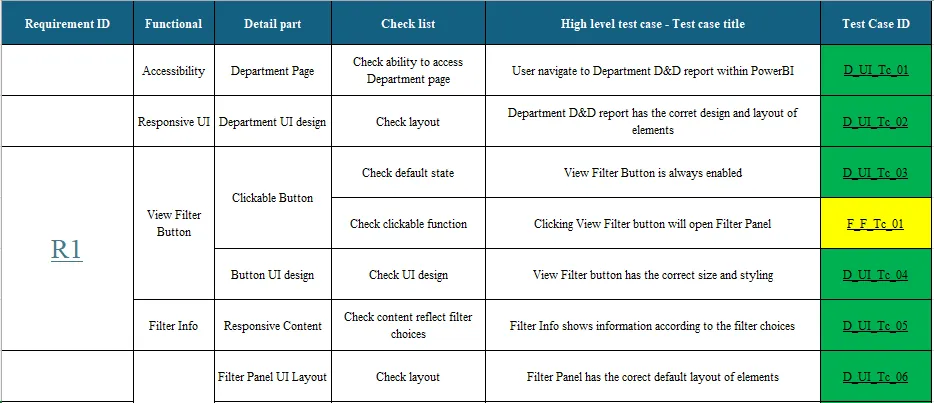
An RTM template
A basic RTM template contains:
- The screen being tested.
- Screen elements that need testing.
- Features (Test Conditions) belonging to that screen, grouped by element.
- Requirements for each Test Condition.
- High Level Test Cases for each Test Condition and Requirement.
- A link to the actual Test Case corresponding to each High Level Test Case.
The point of an RTM is to see which requirements have no test and which requirements each test is tied to. It shows coverage against the traced test basis; it does not prove that we covered 100% of every possible situation.
If a bug appears without a test case, the RTM lets us reach a conclusion quickly:
- The bug may be random and outside the requirements.
- Or we missed a case or a feature. Having an RTM greatly reduces that possibility and makes testing easier.