CHANGE YOUR MINDSET — THE KEY TO TEST AUTOMATION
Moving from manual to automation starts with rethinking tools, ROI, framework design and how the team works together.
27 articles in this topic.
Moving from manual to automation starts with rethinking tools, ROI, framework design and how the team works together.
Playwright MCP and AI agents look great in demos, but token cost, review, retries and operations decide whether a QA workflow has any ROI.
Why an LLM can write beautifully formatted test cases while missing contradictions, inventing test oracles and quietly legalising bugs.
Understand Playwright auto-waiting, actionability and web-first assertions without claiming that the framework magically waits for everything.
How to write a bug report that someone else can reproduce, understand and start fixing without having to guess what the tester meant.
A practical handbook for Manual Testers and new QA practitioners getting started with version control
What progress reports and test completion reports need to answer so the team understands current progress, quality and risk.
The tool groups testers commonly use to manage tests, track bugs, call APIs, query data and collect evidence.
What a bug report needs, how to write actual and expected results, and how severity, priority and evidence help the team handle it.
Turn a high-level test case into a detailed case with preconditions, test data, steps and expected results that someone else can run.
Move from requirements to high-level test cases and a Requirement Traceability Matrix to manage coverage without getting lost in individual actions.
How to apply equivalence partitioning, boundary value analysis, decision tables, state transition and basic white-box techniques.
Classify functional, non-functional, confirmation and regression testing so you know what is being tested and why.
Separate test data from test cases with Test Template and DataDriver, from CSV and Excel to JSON.
Read logs, distinguish failures from errors, and use BuiltIn keywords to catch, continue or deliberately stop tests.
Create user keywords, pass arguments, return values and hide implementation details so test cases read closer to business language.
Documentation, tags, templates, timeouts and the settings commonly used at suite, test-case and keyword level.
When Test Setup, Test Teardown, Suite Setup and Suite Teardown run, their scope, and the easy places to get confused.
How Robot Framework approaches keyword-driven automation testing, and which parts the framework actually provides.
A test process moving from planning, monitoring, analysis, design, implementation and execution to completion in a sprint.
How testers read functional and UI requirements and ask clarifying questions before writing test cases.
How a Test Plan agrees testing scope, resources, schedule, risks and stop conditions.
Distinguish component, integration, system and acceptance testing by their object, objective and participants.
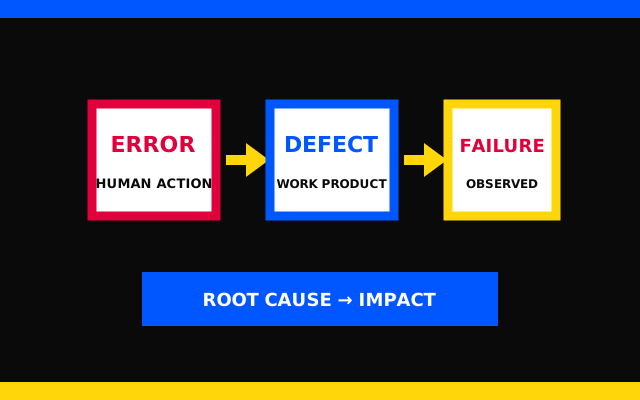
Distinguish root cause, error, defect, failure, severity and priority through real situations in software projects.
How Waterfall and Agile apply the SDLC to a project, and what a tester does in a Scrum sprint.
The stages of the SDLC, what development models are for, and where testing enters the software life cycle.
What software testing does, why teams need testers, and the seven testing principles to understand before going further.